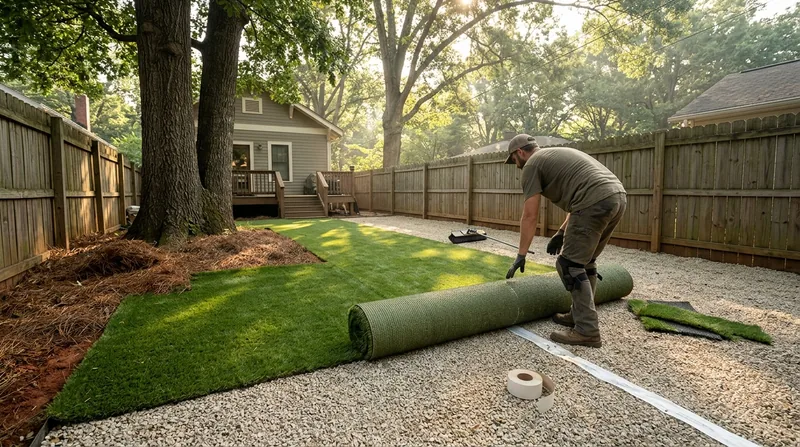




Residential Artificial Grass Installation in Atlanta transforms shade-starved lawns and bare red clay into dense, realistic turf built to handle Atlanta's tree canopy, summer thunderstorms, and sloped terrain. Beneath the Midtown skyline and the densest urban forest in the Southeast, homeowners in Virginia-Highland, Inman Park, Kirkwood, Ansley Park, Druid Hills, Buckhead, Brookhaven, and across Cobb and Gwinnett face a hard truth: fescue and bermuda thin under towering oaks, loblolly pines, and tulip poplars, leaving bare patches and compacted soil. We grade an aggregate base over clay, plan drainage for the slope, and install turf with a written specification in hand so you know exactly what you're getting. No guesswork. No bare dirt left behind. Just a yard that works year-round, even when the rest of Atlanta's lawns are fighting the shade.
Why Artificial Grass Installation Matters in Atlanta's Dense Urban Forest
Atlanta's residential landscape is built on red clay Piedmont hills under one of America's thickest tree canopies. A healthy fescue or bermuda lawn needs 4 to 6 hours of direct sun; most Atlanta yards get 2 to 3. Real grass fails not from neglect but from the trees themselves. Homeowners then face a choice: remove mature oaks and pines, spend thousands on shade-tolerant sod that still thins, or install turf that thrives in the shade and handles the climate.
- We remove the shade problem entirely, converting yards where real grass cannot compete into dense, usable space.
- We grade and compact an aggregate base over clay so water drains away from the house and doesn't pool on sloped lots during Atlanta's summer thunderstorms.
- We specify the turf by face weight, pile height, and infill type so you own the material and can maintain it yourself or hire another company later.
- We handle HOA submittals for front yards in Druid Hills, Buckhead, and other deed-restricted communities, though approval remains the HOA's decision.
In Atlanta's residential market, artificial grass installation is a permanent alternative to the mow-and-thin cycle that real grass cannot break.
Key info: Homeowners in Druid Hills, Ansley Park, and Buckhead often face strict HOA architectural guidelines on front-yard turf color, pile height, and edging. We prepare HOA submittals and coordinate with your architectural committee, but we never promise approval. Check your deed restrictions before you call us.
For detailed information about Atlanta's permitting process and how tree work interacts with residential projects, see the City of Atlanta Development Services page.
How We Install Residential Artificial Grass: From Site Survey to Finished Yard
Our process begins with a site survey to identify drainage patterns, tree root zones, and access constraints. We then excavate, grade the clay to slope away from structures, compact an aggregate base, and lay turf with seams sealed and edges secured. The entire job is documented in writing so you have a record of what was installed and how deep the base sits. We work around existing hardscape, fences, and irrigation lines; Georgia 811 utility locates mark the public lines before we break ground.
- We survey the yard, identify drainage flow, and mark tree roots and utility lines before we touch the ground.
- We excavate to the depth required by your turf specification, typically 2 to 4 inches depending on infill type and base.
- We grade the clay to slope toward the street or downhill so summer thunderstorms drain away from the house.
- We compact the base in lifts to prevent settling, then lay the turf and seal all seams with adhesive.
- We edge the turf with aluminum or steel trim so it stays in place and looks finished against walkways and flower beds.
From excavation to final walkover, a typical residential yard takes 2 to 4 days depending on size, access, and base complexity.
Local example: A 1,200-square-foot backyard in Tucker with a slope toward the street and shallow tree roots required 3 inches of compacted stone base and a drainage layer under the turf. The job took 3 days: excavation and grading on day one, base compaction on day two, and turf installation and edging on day three. The homeowner received a written spec showing 50-ounce turf, 2.5-inch pile height, zeolite infill at 8 pounds per square foot, and 3-inch base depth.
For more on how we handle challenging terrain and drainage issues, see our lawn removal and conversion page.
Residential Artificial Turf Installation Methods: Base Depth, Infill, and Drainage
| Approach | Description | Best for |
|---|---|---|
| Stone Base, 3-4 inches | Compacted crushed stone over clay, graded to slope. Drains surface water and prevents settling. | Most Atlanta residential yards with clay, sloped lots, and summer storm drainage concerns. |
| Recycled Asphalt Base, 2-3 inches | Compacted recycled asphalt over clay. Self-binds and compacts hard. Drains quickly. | Level yards, yards with existing compacted base, or where stone is difficult to access. |
| Permeable Underlayment Layer | Geotextile or permeable mat laid over base before turf. Separates turf from soil, aids drainage. | Yards with poor natural drainage, high water table, or pet urine concerns. |
| Zeolite or Antimicrobial Infill | Mineral or recycled infill spread over turf. Holds the pile upright and aids drainage and odor control. | Pet yards, high-traffic areas, and yards where odor or moisture retention is a concern. |
Residential Artificial Grass Installation Cost in Atlanta: What to Expect
Artificial turf installation in Atlanta starts at around $8 per square foot for a straightforward residential yard with good access and minimal site prep. A typical 1,000-square-foot backyard runs $8,000 to $12,000 installed; a 400-square-foot side yard or patio runs $3,200 to $4,800. The final price depends on several site-specific factors that only an on-site visit can confirm.
- Base depth and compaction: clay yards requiring 3 to 4 inches of stone base cost more than yards with existing hard base or minimal excavation.
- Tree roots and obstructions: yards with shallow oak or pine roots, buried stumps, or dense root masses require careful excavation and may extend the timeline.
- Slope and drainage: sloped lots in Brookhaven, Tucker, or Dunwoody require grading and may need a drainage layer, adding cost.
- Turf specification: face weight (40 to 70 ounces), pile height (1.5 to 2.5 inches), and infill type (zeolite, recycled rubber, or blend) affect the material cost per square foot.
- Access and terrain: narrow side yards, multi-level properties, or yards with limited equipment access may require hand work or smaller machinery, increasing labor.
- Existing hardscape: turf installed around patios, pools, or raised beds costs more than open yards because of edging and detail work.
Getting 2 to 3 written estimates is smart. Each should include the turf product name, face weight, pile height, infill type and rate, base depth, and labor timeline. For a detailed pricing breakdown and examples, see our full pricing page.
Residential Artificial Grass Installation Near Me: What Atlanta Homeowners Should Know When Hiring
Hiring a turf installation company is not like hiring a landscaper or a general contractor. You are paying for a permanent yard surface, so the installer's attention to base prep, drainage, seam work, and material specification matters as much as the turf itself. Before you call, understand what to ask for and how to vet any installer, including us.
- Ask for a certificate of insurance naming general liability and workers compensation; this is the baseline credential, and no installer should balk at providing it.
- Request a written specification listing the turf product, face weight, pile height, infill type and rate per square foot, base type and depth, and compaction method.
- Check references and ask to see photos of finished work, particularly yards in Atlanta with similar shade, slope, or tree conditions.
- Clarify who handles HOA submittals if your yard is deed-restricted; a good installer prepares the paperwork but never guarantees approval.
- Ask whether the installer requests a Georgia 811 utility locate before breaking ground and how they mark private lines like irrigation and pet fencing.
- Get the timeline in writing: how many days the job takes and whether weather delays are communicated in advance.
Avoid installers who quote a price without visiting the site, who lay turf on bare dirt without a base, or who cannot name the turf product and its specifications. A reputable turf installer works from a written plan and stands behind it. Ready to talk with us? Call us at (470) 943-2510 for a free, no-obligation estimate.
Residential Artificial Grass Installation in Atlanta: Pricing Guide
| Service | Price | Details |
|---|---|---|
| Residential yard, 400-600 sq ft | Starting at $8/sq ft | Small side yard or patio conversion. Includes 2-3 inch stone base, standard turf, seams sealed, aluminum edging. |
| Residential yard, 800-1,200 sq ft | Starting at $8-$10/sq ft | Typical backyard. Cost rises with slope, tree roots, or drainage layer needed. Base depth and compaction are the main variables. |
| Residential yard, 1,500+ sq ft or complex site | Starting at $9-$12/sq ft | Large yards, multiple slopes, shallow tree roots, or proximity to structures. Requires site visit to confirm base depth and access. |
| HOA front-yard submittals or deed-restricted installation | No additional fee | Included in estimate. We prepare architectural review paperwork, but HOA approval is not guaranteed and remains the HOA's decision. |
| Estimate and site survey | Free | Response within 24 hours. No obligation to book. Includes written spec with turf product, face weight, pile height, and base depth. |
Indicative pricing, the exact cost depends on square footage, finish, and site access. Free personalized estimate within 24h at (470) 943-2510.


