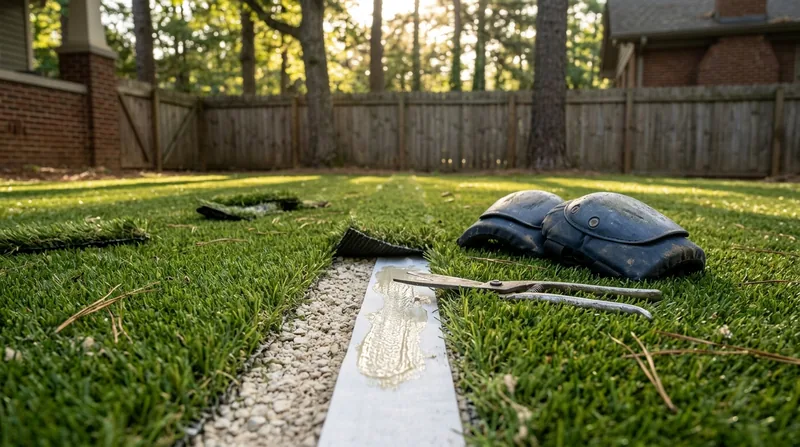




Atlanta's rolling Piedmont terrain, dense tree canopy, and summer thunderstorms create a perfect storm for artificial turf damage. Edges undercut by runoff on sloped lots in Druid Hills and Brookhaven; seams split by freeze-thaw cycles and UV exposure; traffic lanes flattened by foot traffic near patios in Inman Park; bright window reflections melting turf in brick Craftsman homes. Turf repair and seam repair in Atlanta restores these problem zones without replacing the entire lawn. We cut out the damaged section, patch it with new turf, re-seam the edges, and re-infill so the repair disappears into the surrounding lawn. Since 2013, we have fixed hundreds of yards across Atlanta, Decatur, Brookhaven, Dunwoody, Tucker, and surrounding areas, working on residential yards, commercial properties, and pet turf installations.
Why Turf Damage Happens So Fast in Atlanta's Climate
Atlanta sits on red-clay Piedmont hills under one of the densest urban tree canopies in America. Summer humidity, afternoon thunderstorms, and intense sun create stress patterns that damage even well-installed turf. Sloped yards shed water fast, undercutting edges and lifting seams. Shade from towering oaks and loblolly pines thins the turf itself, making it more vulnerable to wear. Window reflections from second-story glass on brick homes can reach temperatures that soften and melt synthetic fibers. Foot traffic on pet turf and around pool surrounds flattens the pile into permanent traffic lanes.
- Runoff on sloped lots cuts under edges, especially in Virginia-Highland, Ansley Park, and Druid Hills where yards sit on hillsides.
- Seams fail when freeze-thaw cycles stress the adhesive, most common in late winter and early spring across the metro.
- Window reflections and direct sun exposure melt spots into the pile, visible on south-facing and west-facing installations.
- Heavy foot traffic flattens pile in high-use zones, common on pet turf and around pool decks in residential yards.
- Tree shade and moisture retention weaken the base, leading to soft spots and lifted sections over time.
Catching damage early prevents small repairs from becoming full replacements. A split seam repaired in spring costs far less than replacing 500 square feet of turf in summer.
Key info: Atlanta's summer humidity and afternoon thunderstorms accelerate turf wear. A yard that looks fine in May can show seam splits and edge lift by August. Regular inspection, especially after heavy rain and before peak heat, catches problems when repair is still an option.
For more detail on how to maintain your turf between repairs, see our guide to turf cleaning and pet odor treatment.
How We Repair and Seam Turf in Atlanta
Our repair process is straightforward and leaves no visible trace. We inspect the damage, remove the affected section with a sharp cutter, remove old infill from the repair zone, prep the base if needed, install new turf matched to your existing product, seam the edges with turf adhesive, and re-infill to match the surrounding lawn. The key is matching the original turf face weight, pile height, and infill type so the patch reads as part of the original installation, not a visible fix.
- We inspect the damage on site and identify the root cause (edge undercutting, seam separation, melt spot, traffic wear).
- We cut out the damaged area cleanly, removing turf and old infill down to the base layer.
- We check and prep the base (compact, level, and drain) so the new section sits flush with the surrounding turf.
- We source new turf matched to your existing product, face weight, and pile height from our inventory or supplier.
- We install the new section and seam it to the surrounding turf using turf-grade adhesive and a heat sealer.
- We re-infill the repair zone and blend it with the existing infill so the entire lawn looks uniform.
- We rinse the area and let the seam cure before foot traffic.
Most small repairs (under 50 square feet) take 2 to 4 hours. Larger jobs or multiple seams may take a full day. We work around your schedule and minimize disruption to your yard.
Example: A homeowner in Brookhaven noticed a split seam running 8 feet along the edge of her pool surround after a spring freeze. The adhesive had failed on both sides of the seam. We cut out a 2-foot-wide strip on either side of the split, removed the old infill, prepped the base, installed new turf matched to her existing product (60-ounce polyethylene with silica sand infill), re-seamed the entire 16-foot run, and re-infilled. The repair took 5 hours and cost $680. The seam is now invisible and as strong as the original installation.
For residential yards that need full replacement or conversion, see our residential artificial grass installation page.
| Repair Type | Description | Best For |
|---|---|---|
| Edge Undercutting | Cut back the lifted edge, re-level the base, and re-install a new edge with adhesive and stakes or edging. | Sloped yards where runoff has undermined the perimeter, common in Druid Hills and Virginia-Highland. |
| Seam Separation | Remove the failed seam, clean the turf edges, apply new adhesive, and heat-seal the joint with a sealer gun. | Cold-weather seam failure or UV-damaged adhesive, especially visible in spring and early summer. |
| Melt Spots and Window Reflections | Cut out the melted section, install new turf, and re-infill to match the surrounding lawn. | South and west-facing yards with reflective glass, common in brick Craftsman homes with second-story windows. |
| Traffic Lane Flattening | Brush the pile to restore texture, or cut out and replace the worn section if brushing does not recover the pile. | High-use areas on pet turf and pool surrounds where foot traffic is concentrated. |
| Base Settlement and Soft Spots | Cut out the soft section, remove old infill, re-compact the base, and install new turf and infill. | Shaded areas where moisture retention has weakened compaction, or yards with poor initial base prep. |
Each repair type requires a different approach. We diagnose the root cause on site so you know what happened and how we are fixing it.
Turf Repair and Seam Repair Cost in Atlanta: What to Expect
Turf repair pricing depends on the size of the damage, the complexity of the seam, whether the base needs prep work, and how well we can match your existing turf. A small edge repair or single seam fix starts at $350 to $500. Larger patches (50 to 200 square feet) or multiple seams run $600 to $1,500. Full-yard seam replacement or extensive base work goes higher and requires an on-site estimate. We measure the damage, identify the turf product and infill type, and give you a firm quote before we start work.
Travel is included across Atlanta and surrounding areas. We respond to free estimate requests within 24 hours at (470) 943-2510. For a full breakdown of pricing across all our services, see our pricing overview.
Cost factors: A simple seam repair on a straight line costs less than a multi-angle seam around a pool. Edge work on a sloped lot takes longer than edge work on flat ground. Matching a discontinued turf product takes sourcing time and may cost more. Repairs on pet turf with antimicrobial infill require that specific infill type, which affects the total. We always tell you the factors before quoting.
What to Look for When Hiring a Turf Installation Company Near Me in Atlanta
Not every turf company that installs new yards can repair and seam turf well. Seaming is a craft, and a poor seam will fail again in 12 months. When you call a turf installer for repair work, ask for proof that they have done seam repair before, and ask to see photos of finished repairs on similar yards. Ask for references from homeowners in your neighborhood (Brookhaven, Decatur, Tucker, Dunwoody) so you can call and ask how the repair held up over time.
- Request a certificate of insurance showing general liability and workers compensation coverage, and ask that we name you as an additional insured.
- Get a written spec for the repair that names the turf product, face weight, pile height, infill type and pounds per square foot, and base depth.
- Ask for local references from repair jobs completed in the past 12 months, and call them to ask how the repair has held up.
- Get multiple estimates so you understand the range and can compare approach, timeline, and warranty on the seam work.
- Ask about the seam adhesive and heat sealing method, and whether the company stands behind the seam with a warranty.
- Verify that the company understands your turf product and infill type, and can source matching materials if needed.
We are fully insured and provide a written spec for every repair job. We stand behind our seam work with a one-year workmanship warranty on the adhesive and sealing. Call us at (470) 943-2510 to discuss your repair and get a free estimate, or contact us online for a response within 24 hours.
Turf Repair & Seam Repair in Atlanta: Pricing Guide
| Service | Price | Details |
|---|---|---|
| Small edge or seam repair | Starting at $350 | Single seam or edge section under 30 square feet, including adhesive, heat sealing, and infill blending |
| Medium patch or multi-seam job | Starting at $600 | Repair covering 30 to 100 square feet or two or more seams, including base prep and new turf installation |
| Large patch or extensive seam work | Starting at $1,200 | Repair covering 100 to 300 square feet or complex multi-angle seaming around pools and features |
| Full yard seam replacement or base work | On estimate | Extensive seam failure, base settlement, or multiple damage zones across the entire installation require on-site inspection |
| Travel | Included | No mileage fee or travel charge for Atlanta, Decatur, Brookhaven, Dunwoody, Tucker, and surrounding service areas |
| Free estimate | No obligation | Response within 24 hours at (470) 943-2510, on-site inspection and written quote before any work begins |
Indicative pricing, the exact cost depends on square footage, finish, and site access. Free personalized estimate within 24h at (470) 943-2510.


