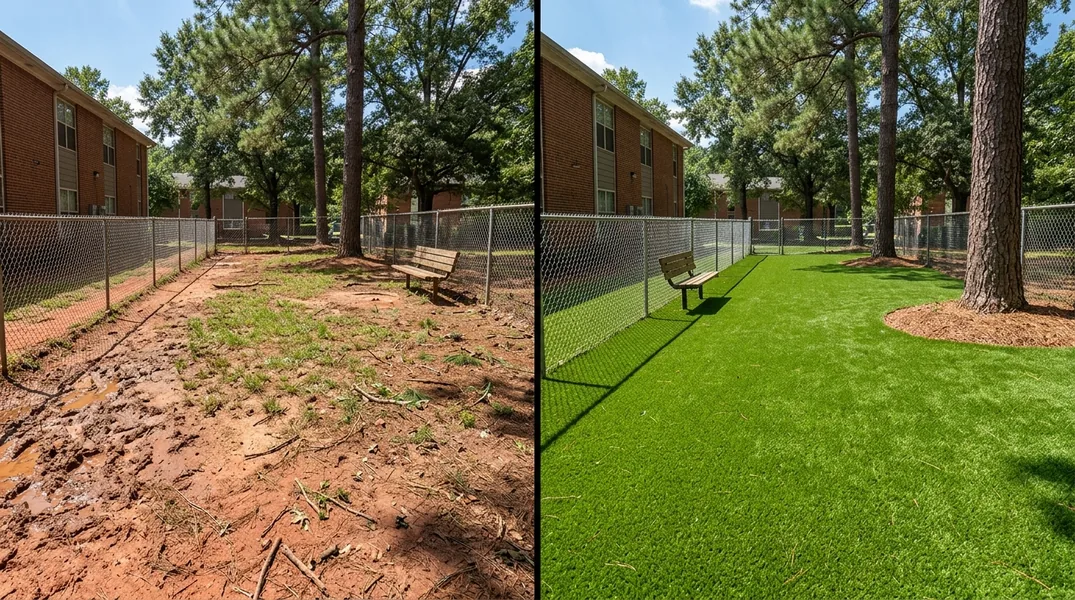
Why Red Georgia Clay Demands Special Attention for Artificial Grass
If you own a home in Atlanta, you know the distinctive red clay that defines our landscape. While beautiful, this clay presents unique challenges when installing artificial turf. Red Georgia clay is dense, compacts easily, and drains poorly, which means water can pool beneath your new lawn rather than flowing away. This creates soft spots, promotes mold growth, and ultimately shortens the lifespan of your investment.
The good news is that these challenges are entirely manageable with proper planning and execution. Residential Artificial Grass Installation on clay requires a strategic approach to base preparation and drainage that goes beyond standard installations. Understanding what lies beneath your turf is just as important as selecting the right grass product itself.
What to Put Under Artificial Grass: The Foundation Layer Strategy
The question of what to put under artificial grass is fundamental, and the answer depends heavily on your existing soil conditions. On red clay, we start by removing the top two to three inches of existing sod and vegetation. This exposes the clay layer and gives us a clean slate for proper base construction. The clay itself won't be completely removed, but it will be graded and compacted to create a stable, level foundation.
Once the site is prepared, the next layer is crushed limestone or recycled asphalt millings. This base layer, typically four to six inches thick, serves multiple purposes. It provides structural support, helps with initial drainage, and creates a more forgiving surface than bare clay. Over the limestone, we add a layer of coarse sand, about two inches, which further improves drainage and provides a smooth, cushioned surface for the artificial grass. This sand layer is critical because it prevents the turf from settling unevenly and helps distribute foot traffic loads across the base.
Finally, the Atlanta clay environment requires a high-quality artificial grass underlay. This geotextile fabric sits directly under your turf and acts as a barrier against clay particles working their way up while still allowing water to pass through. Skipping this step or choosing a cheap underlay is false economy, as you'll likely face drainage issues within the first year or two.
Artificial Grass Drainage Solutions for Clay Soils
Proper artificial grass drainage is perhaps the most critical factor in ensuring your turf lasts for years without developing soft spots or foul odors. Clay naturally sheds water, which means that without intervention, water will sit on top of or just below your new lawn. The solution involves creating a drainage pathway that channels water away from the installation area efficiently.
For most residential properties in Decatur and surrounding areas, we install a perimeter drainage system. This involves placing perforated drain pipe along the edges of the turf installation, typically at the lowest point of the yard. The pipe sits in a bed of gravel and connects to a drainage outlet or French drain system that carries water away from your home's foundation and landscape. This approach prevents water from pooling and ensures that even heavy Atlanta rainfall drains away quickly.
For properties with significant slopes or chronic drainage problems, we may recommend a more comprehensive subsurface system. This involves installing drainage channels or a complete sand and gravel base with integrated drainage layers. While this requires more upfront investment, it guarantees that water management won't be an issue for the life of your turf. The cost difference is minimal compared to the frustration of dealing with water problems after installation is complete.
Turf Base Prep on Sloped Lots: Grading and Stability
Sloped yards present both opportunities and challenges for artificial grass installation. The natural slope can actually help with drainage, but improper grading can lead to erosion, uneven settling, and visible seams or wrinkles in your turf. Turf base prep on sloped terrain requires careful attention to slope direction and stabilization techniques.
The first step is to assess the existing grade and determine the optimal slope for water runoff. Ideally, your lawn should slope away from your home at a gentle gradient, roughly one inch of drop for every eight to ten feet of distance. If the existing slope is too steep or in the wrong direction, we'll regrade the area to optimize both drainage and aesthetics. On clay, this regrading must be done carefully to avoid creating hard-packed areas that resist water infiltration.
Once grading is established, stabilization becomes essential. We use landscape fabric and, in some cases, erosion control matting to prevent the base materials from shifting downhill. The limestone and sand layers are compacted in stages as we move down the slope, ensuring each section is stable before adding the next layer. This staged approach prevents the entire base from sliding or settling unevenly over time. For steep slopes or problem areas, we may install geotextile reinforcement layers that work with the base materials to create a stable, unified foundation for your artificial turf.
The Complete Installation Process: From Clay to Finished Turf
Understanding the complete installation timeline helps homeowners appreciate why proper base preparation takes time and expertise. From the initial site evaluation through final turf installation, the process typically spans two to three weeks, depending on yard size and complexity. This isn't wasted time, it's an investment in longevity and performance.
The process begins with a detailed site assessment where we evaluate drainage patterns, existing vegetation, slope, and soil conditions. We'll identify any areas of concern, such as low spots that collect water or clay layers that are particularly dense. Based on this assessment, we develop a customized drainage and base preparation plan specific to your property. We then remove existing vegetation, regrade as needed, and install the base layers in the proper sequence. Each layer is compacted and inspected before moving to the next step. Only after the foundation is absolutely solid do we install the artificial grass underlay and turf itself. This methodical approach ensures that your new lawn will perform beautifully for fifteen to twenty years or more.
If you're considering Residential Artificial Grass Installation in Brookhaven, Dunwoody, or anywhere in the metro area, the team at Atlanta Turf Installation brings years of experience managing Georgia's unique clay soils. We understand the challenges and know exactly how to solve them. Contact us today at (470) 943-2510 to schedule a free estimate and learn how we can transform your yard into a beautiful, low-maintenance landscape that thrives despite Georgia's challenging terrain.
Looking for a professional artificial grass installation company in Atlanta? Atlanta Turf Installation responds fast for all your artificial grass installation needs.
Get a Free Quote